
This article contains affiliate links. If you purchase through these links, we may earn a commission at no additional cost to you. This helps support our website and allows us to continue creating free content. Our recommendations are based on our independent research and editorial standards.
Changing careers sounds exciting when you imagine the end result.
A new industry. A different type of work. New skills. Maybe a role that actually feels closer to where you want your life to go.
The difficult part is everything in between.
How do you know which career to choose? What skills do you actually need? How do you learn them without going back to school for years? And perhaps the biggest question of all: how do you convince an employer to take you seriously when most of your previous experience comes from another industry?
That is where online learning can make a career switch much more realistic.
Instead of trying to start from zero, you can identify the skills your target industry needs, learn them systematically, build projects around those skills and then reposition the experience you already have.

Udemy can be particularly useful because it gives career switchers access to courses across technology, business, data, marketing, finance, project management, design, leadership and many other fields. Its current career-development catalogue also includes dedicated courses covering career transitions, transferable skills, personal branding and job-search strategy.
The trick is knowing how to use Udemy as part of a career-switch strategy rather than simply collecting certificates.
Can Udemy really help you change careers in 2026?
Yes, but Udemy works best as a structured skills-building tool rather than a shortcut into a new job.
You shouldn't approach a career change by searching for one course called "Become a Data Analyst" and expecting it to solve everything.
A better approach is to work backwards from the role you want.
Find the job titles.
Study the skills employers are asking for.
Identify what you already know.
Find the gaps.
Then use Udemy to fill those gaps.
For example, someone moving into data analytics might need Excel, SQL, Power BI, statistics and data visualisation.
Someone moving into digital marketing might need SEO, analytics, content strategy, paid advertising and social media.
Someone moving into cloud computing might need networking fundamentals, Linux, AWS, Azure or Google Cloud.
The course is only one part of the transition.
The strategy around it is what makes the learning useful.
What is the smartest way to use Udemy for a career change?
Use Udemy to build a targeted learning plan around a specific job rather than taking random courses.
A simple process looks like this:
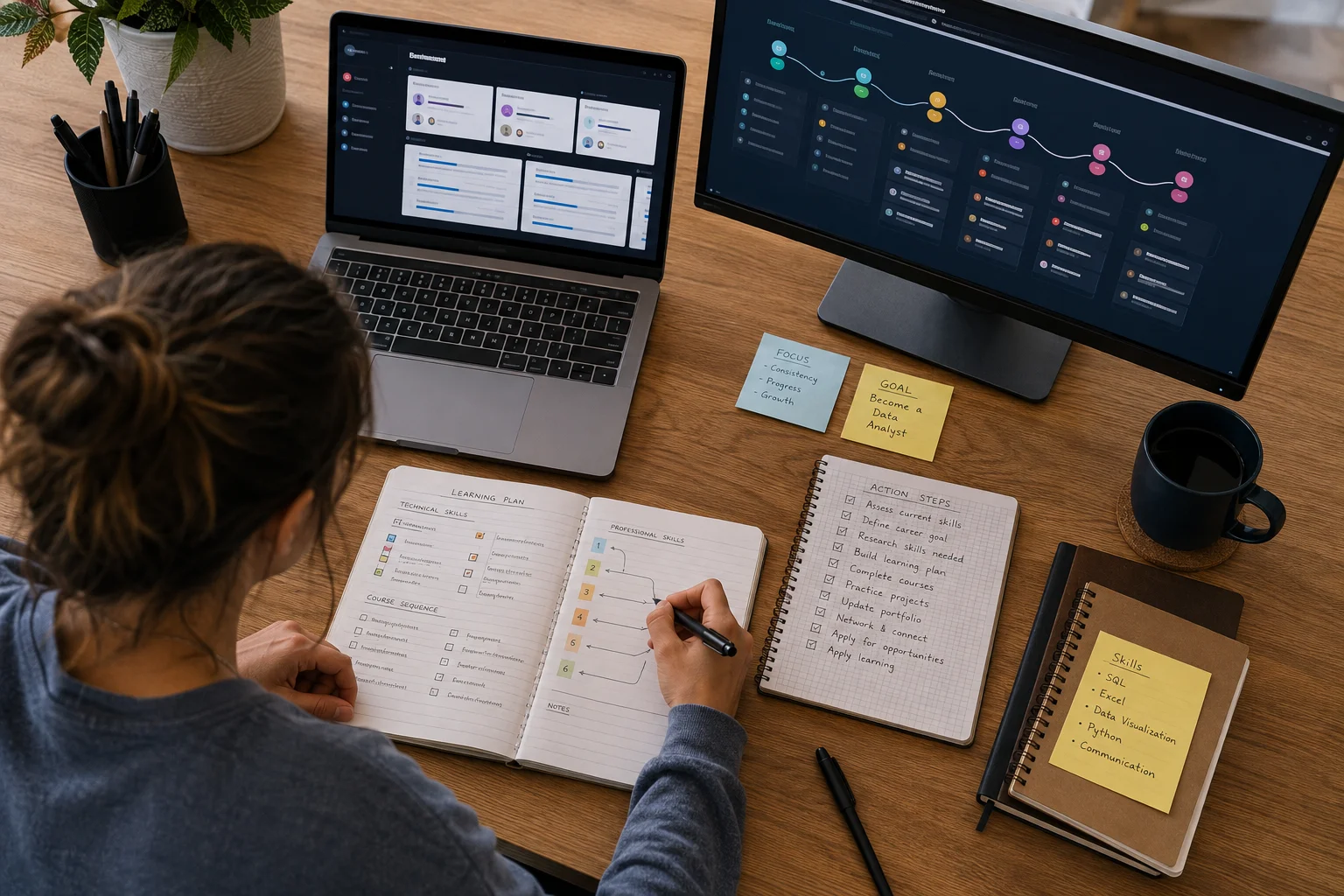
Choose a target role → research required skills → identify your gaps → select Udemy courses → practise → build projects → reposition your CV and LinkedIn profile → apply.
This prevents one of the biggest problems career switchers face.
Learning without direction.
It is very easy to spend months taking interesting courses without becoming noticeably more employable.
Your learning should always connect back to the job you want.
Step 1: Decide what industry you actually want to enter
Don't start with a course; start with the destination.
"Something in technology" isn't specific enough.
Neither is "I want a better career."
Try to narrow it down to a role.
You might be considering:
You don't need to know the exact job title immediately.
But you need a direction.
Udemy's current career-development catalogue includes courses designed specifically around career decisions and career transitions. For example, What Career Should I Choose? A Proven Decision Framework was updated in July 2026 and is designed to help learners compare career options and make more structured career decisions.
That kind of course can be useful before you start spending serious time on technical learning.
Step 2: Work out which skills transfer from your current career
A career switch does not mean throwing away everything you've learned so far.
This is one of the biggest mistakes people make.
Imagine someone working in customer service who wants to move into project management.
They may already have experience with communication, problem-solving, stakeholder management, deadlines and handling difficult situations.
Those skills don't disappear because the job title changes.
The same applies to someone moving from finance into data analytics.
They may already understand numbers, reporting, business performance and financial modelling.
The new skills might be SQL, Power BI and data visualisation.
Your job is to find the bridge between the experience you already have and the skills your new industry needs.
Udemy's current career-change courses specifically address this issue. Career Transition Strategies: Moving to a New Industry, updated in March 2026, focuses on transferable skills, skills development, networking and building a demonstrable portfolio for a new industry.
Step 3: Research real job descriptions before choosing courses
Job descriptions are one of the best ways to discover what you actually need to learn.

Find several job postings for the type of role you want.
Don't look at just one.
Write down the skills that appear repeatedly.
For example, if you're targeting junior data analyst roles and most postings mention:
Excel
SQL
Power BI
Data visualisation
Basic statistics
you now have a much clearer learning plan.
You don't need a course covering 25 unrelated subjects.
You need to become credible in those five areas.
This also helps you avoid wasting time learning skills that sound impressive but aren't particularly relevant to your target role.
Step 4: Use Udemy to close the specific skill gaps
Once you know your gaps, Udemy becomes much more powerful because you can use individual courses strategically.
You don't have to follow one giant programme from beginning to end.
You can combine courses according to your needs.
For example:
Career switch into data analytics
Start with Excel.
Move into SQL.
Learn Power BI.
Add statistics.
Build several analytical projects.
Career switch into cybersecurity
Start with networking and security fundamentals.
Move into ethical hacking.
Learn security tools.
Study cloud security.
Build a practical portfolio.
Career switch into web development
Start with HTML and CSS.
Learn JavaScript.
Move into React.
Add backend development.
Build real websites and applications.
This is one of the strongest advantages of Udemy.
You can create a learning path around your career goal rather than being locked into a single curriculum.
Step 5: Use current Udemy courses instead of outdated material
For a career switch, course freshness matters because technology and workplace expectations change quickly.

This is particularly important in fields such as AI, cybersecurity, cloud computing, data analytics and software development.
Udemy's current catalogue contains courses updated throughout 2026, including career-transition programmes and courses focused on emerging technologies and changing workplace skills. Its Future Skills: Emerging Technologies & Career Strategy course, for example, covers AI, automation and changing career requirements.
When choosing a course, look at:
Last updated date
Course curriculum
Student ratings
Number of learners
Practical projects
Exercises and assignments
Whether the technology or certification is current
Don't automatically choose the oldest course with the largest student count.
Step 6: Don't collect certificates. Build evidence.
A certificate can show that you completed a course, but a project can show what you can actually do.
This is one of the most important rules for career switchers.
If you are moving into data analytics, don't just list five analytics courses on your CV.
Build a dashboard.
Analyse a dataset.
Write SQL queries.
Explain what the data means.
If you're moving into web development, don't simply say you've completed a JavaScript course.
Build a website.
Create a web application.
Put your work somewhere an employer can see it.
If you're moving into digital marketing, create a campaign strategy, content plan or SEO project.
The objective is to turn learning into evidence.
That makes your career change much easier to explain.
Step 7: Build a portfolio around your new industry
Your portfolio should make it obvious that you've started doing the work of your target industry.
You don't need 20 projects.
Three or four good projects can be much more useful.
Each project should answer three questions:
What was the problem?
What did you do?
What was the result?
For a data project, explain what you analysed and what insights you found.
For a web project, explain what you built and which technologies you used.
For a marketing project, explain the strategy and expected outcome.
This changes the conversation from:
"I've never worked in this industry."
to:
"I've been building these skills and here is the work I've produced."
That is a much stronger position.
Step 8: Use Udemy for both technical and professional skills
A successful career switch usually requires more than technical knowledge.

Suppose you learn Python.
You may still need to improve your CV.
You may need to update LinkedIn.
You may need to practise interviews.
You may need to learn how to explain your previous experience in a way that makes sense to your new industry.
Udemy's current career-development catalogue includes courses around career planning, professional relationships, managing up, productivity and other workplace skills alongside technical subjects.
That makes it possible to use one learning platform for both sides of the transition.
Technical skills get you closer to being qualified.
Professional skills help you communicate that value.
Step 9: Reposition your existing experience
Don't hide your old career on your CV; translate it.
A career switcher often makes the mistake of presenting themselves as a complete beginner.
That can make years of experience look irrelevant.
Instead, identify the parts of your previous career that transfer.
A salesperson moving into account management already understands clients.
A teacher moving into corporate training already understands communication and learning.
A finance professional moving into business analytics already understands business numbers.
A project coordinator moving into project management already has experience with deadlines, stakeholders and organisation.
Your new skills should sit alongside your existing strengths.
That combination can become your advantage.
Step 10: Create a 90-day career-switch plan
A defined timeline makes a career change feel much more manageable.

You don't need to completely reinvent yourself in one month.
Instead, divide the transition into stages.
Days 1–30: Research and foundations
Choose your target role.
Study job descriptions.
Identify your transferable skills.
Find your biggest skill gaps.
Start the first Udemy course.
Days 31–60: Build practical skills
Continue your core learning.
Start a project.
Practise the tools employers mention most often.
Update your LinkedIn profile.
Begin talking to people already working in the industry.
Days 61–90: Build evidence and apply
Complete your projects.
Create your portfolio.
Rewrite your CV around transferable skills.
Practise interviews.
Start applying for suitable roles.
This approach is also reflected in newer Udemy career-transition courses. Career Transition: Moving Into a New Industry, updated in August 2026, focuses on transferable skills, skills-gap analysis, projects, personal branding and a step-by-step transition roadmap.
Which Udemy career-change courses are worth exploring?
Udemy has several current courses that can support the career-change process itself, before you even start learning your new technical skill.
Career Transition Strategies: Moving to a New Industry
This course was updated in March 2026 and focuses specifically on moving into a different industry.
It covers transferable skills, career-transition strategies, networking and building a portfolio that demonstrates relevant capabilities.
Change your career with the help of a virtual Career Coach
Updated in August 2026, this course focuses on identifying a new career direction, understanding the skills and training required, creating an action plan and developing a growth mindset.
It also includes CV guidance using AI.
Career Transition: Moving Into a New Industry
Updated in August 2026, this newer course focuses on transferable skills, target-industry research, skills-gap analysis, projects, personal branding, CVs, LinkedIn and a structured transition plan.
Career Change
Updated in June 2026, this course focuses on making previous experience useful in a new field, identifying transferable skills, choosing a realistic career direction and repositioning your CV and interview answers.
Career Change - Find Your Perfect Job
This course was updated in June 2026 and takes a broader five-step approach covering career exploration, testing new opportunities, entering a new career and sustaining the transition.
You can then pair one of these career-transition courses with technical courses in the industry you want to enter.
That combination is far more useful than simply taking a generic "career change" course and stopping there.
Can you switch industries without going back to university?
Yes, depending on the industry and role, targeted online learning can give you a practical alternative for developing new skills.

Some professions have formal qualifications or licensing requirements that you cannot replace with an online course.
But many technology, business, marketing, analytics and creative roles are much more skills-focused.
In those areas, your ability to demonstrate relevant knowledge and practical work can become extremely important.
That is where platforms such as Udemy can be useful.
You can learn a specific skill without having to commit to a completely new multi-year education path.
The key is to be realistic about what an online course can do.
It can teach you.
It can give you exercises.
It can help you build projects.
It can give your learning structure.
But you still need to practise and prove that you can use the skill.
How should you choose Udemy courses for a career switch?
Choose courses based on the job you want, not on how impressive the course title sounds.
Before enrolling, ask:
Does this teach a skill that appears in my target job descriptions?
Has it been updated recently?
Does it include practical work?
Is it suitable for my current level?
Will I be able to create something I can show an employer?
Does it help me move towards a recognised certification where one matters?
If the answer is yes to most of these questions, the course is probably worth considering.
Udemy's current career-development catalogue also highlights top-rated courses, popular programmes and guidance from instructors with real-world experience, giving career switchers several ways to evaluate learning options.
What mistakes should career switchers avoid?
The biggest mistake is confusing learning with career progress.
Watching 50 hours of videos feels productive.
But if you cannot demonstrate what you learned, you haven't finished the important part.
Avoid:
Taking courses without a target role
Collecting certificates without projects
Trying to learn everything at once
Ignoring transferable experience
Applying only after you feel "fully ready"
Using an outdated curriculum
Copying projects without understanding them
Completely rewriting your career history instead of repositioning it
Your goal isn't to become an expert in your new industry before applying.
Your goal is to become credible enough to make the transition.
How long does a career switch take with Udemy?
There is no fixed timeline because the answer depends on your starting skills, target industry and the complexity of the new role.
Someone moving from marketing into digital analytics may already have useful business knowledge.
Someone moving from a non-technical role into cybersecurity may need much more foundational learning.
Don't measure progress only by hours of courses completed.
Measure it by what you can now do that you couldn't do before.
Can you build something?
Can you explain the concepts?
Can you solve a realistic problem?
Can you discuss the subject confidently in an interview?
Those are much better indicators of progress.
What is the best way to use Udemy during a career switch?
Treat Udemy like your personal skills-building library rather than a single course you need to finish.

Use one course to establish fundamentals.
Use another to develop a specialist skill.
Use a project-based course to practise.
Use career-development courses to improve your CV, LinkedIn profile and interview strategy.
Then return to the technical catalogue whenever you identify another skill gap.
This is where Udemy's breadth becomes particularly useful.
The platform currently spans career development alongside subjects such as technology, business, data, design and other professional skills, allowing learners to build a customised learning path around their career objective.
You don't have to start again from zero.
You can build forward from what you already know.
Career Switching with Udemy FAQs
Can Udemy help me change careers?
Yes. Udemy can help you develop skills for a new career and also offers courses specifically focused on career transitions, transferable skills, personal branding and job searching.
Should I take a career-change course before a technical course?
It can be useful if you are unsure about your target role. A career-transition course can help you identify transferable skills, research industries and create a learning plan before you start technical training.
Can I switch industries without previous experience?
Yes, depending on the industry and role. The important thing is to build relevant skills and evidence while using your existing experience to demonstrate transferable capabilities.
Are Udemy certificates enough to get a new job?
No certificate should be treated as a guarantee of employment. Use courses to develop practical skills and then demonstrate those skills through projects, portfolios, interviews and relevant experience.
How many Udemy courses should I take for a career change?
There is no ideal number. Start with the smallest learning path that closes the most important skill gaps for your target role. Quality and relevance matter more than the number of completed courses.
What if I don't know which career I want?
Start with career-exploration and decision-making resources before committing to technical training. Udemy currently has courses specifically designed to help learners compare career options and make more structured career decisions.
Should I put Udemy courses on my CV?
Relevant courses can be included, particularly when they demonstrate skills required for your target role. However, place greater emphasis on projects, practical skills and outcomes rather than creating a long list of course titles.
Can Udemy help me prepare for interviews after a career switch?
Yes. You can combine technical learning with courses covering communication, career development, personal branding, interview preparation and professional skills. Udemy's career-development catalogue includes a broad range of professional-development content.
Is it better to take one large Udemy course or several smaller courses?
It depends on the career. A large bootcamp can provide structure when you're starting from zero, while smaller courses can be better when you already understand the basics and only need to close specific skill gaps.
What is the biggest advantage of using Udemy for a career change?
Flexibility. You can build a learning path around your target role, existing experience and available time rather than following the same curriculum as everyone else.
Final Thoughts
A career switch doesn't have to mean starting your professional life again.
You already have experience.
You already know how to work with people, solve problems, communicate, manage deadlines or deal with customers. The challenge is learning how to connect those existing strengths to a new industry.
That's where a platform like Udemy can become genuinely useful.
Use it to research your options.
Use it to identify the skills you're missing.
Use its courses to learn those skills.
Then turn the learning into projects, portfolio pieces and stronger conversations with employers.
The current Udemy catalogue has dedicated career-transition courses alongside technical and professional learning across a wide range of industries. Some of the newest career-transition programmes have been updated during 2026 and specifically address transferable skills, skills-gap analysis, personal branding and structured transition plans.
But don't make the mistake of thinking the goal is to complete as many Udemy courses as possible.
The goal is to become capable of doing something valuable in your new industry.
One useful skill.
Then another.
Then a project.
Then another.
Eventually, your old career stops being something you need to escape from and becomes part of the story that makes your new career more interesting.

Written By
Samuel Green
Career Content Specialist — 10+ years covering recruitment and career development.